On this page
What three settings decide how clean the glasses come out?#
Water hardness, salt and rinse aid. The softener needs the right hardness value and salt, and the reservoir needs rinse aid. Get those three right and most spots, cloudy film and streaks go away. 1
This guide follows the Miele Operating Instructions for the G 5670 and G 5675 dishwashers (M.-Nr. 09 510 241, US and Canada edition). The manual's logic is simple: to achieve good cleaning results the dishwasher needs soft water, because hard water leaves calcium deposits on dishware and inside the machine. If your tap water hardness is above 4 gr/gal (4 °d), the water should be softened. 1
How is the water hardness entered?#
Choose the value that matches your supply from the settings menu and confirm it with the center button. The factory value is 1 gr/gal, so almost every kitchen needs a change. In areas where hardness varies, program the higher value. 1
Get the figure from your local water authority. The manual gives an example of a range from 37 to 50 °d (39 to 52 gr/gal), where you would program the highest value. 1 It also says to note the number in the manual, because a technician will want it if there is ever a problem. 1 Two more details: the built-in softener is suitable for hardness up to 70 °d (73 gr/gal), and the basic settings are saved after the first full program cycle. 1
The water hardness setting also controls a message. The Insufficient salt message is switched off if you program the dishwasher to a hardness below 4 gr/gal. 1 If you never see a salt message, your hardness setting might be the reason. That is fine only if your water is truly soft.
How do I fill the salt container?#
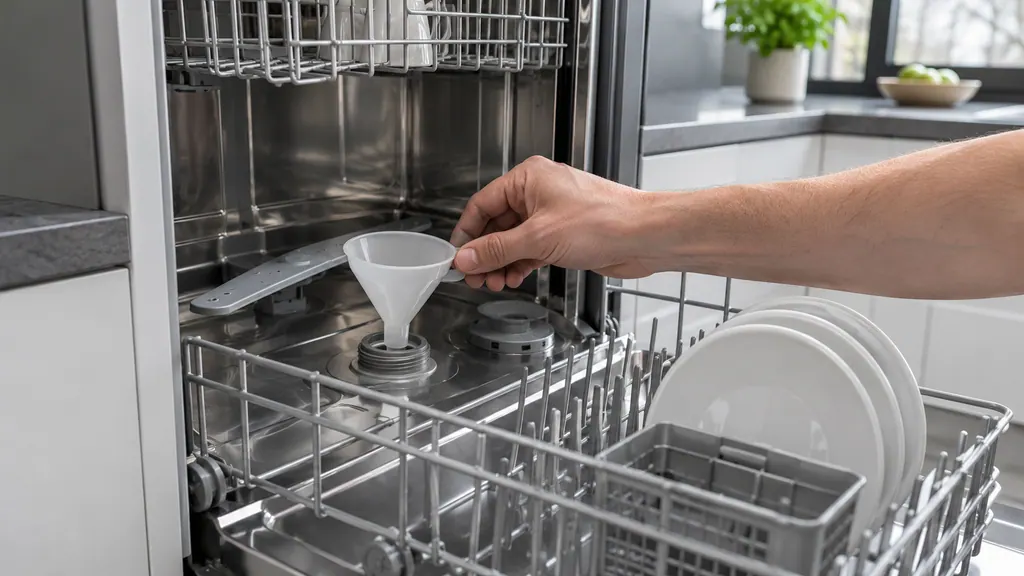
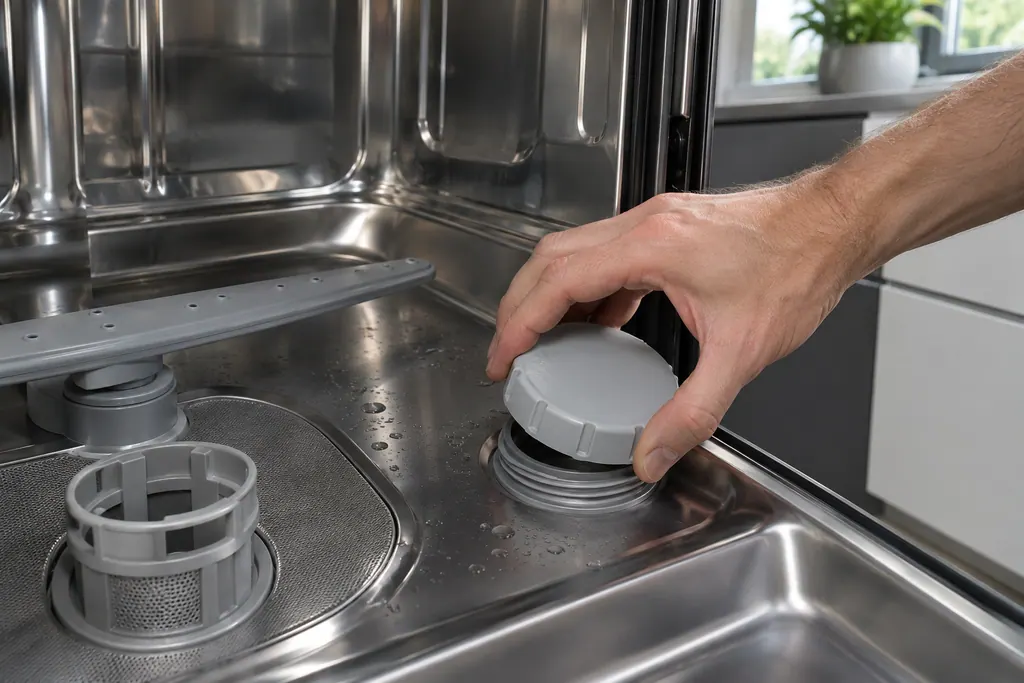
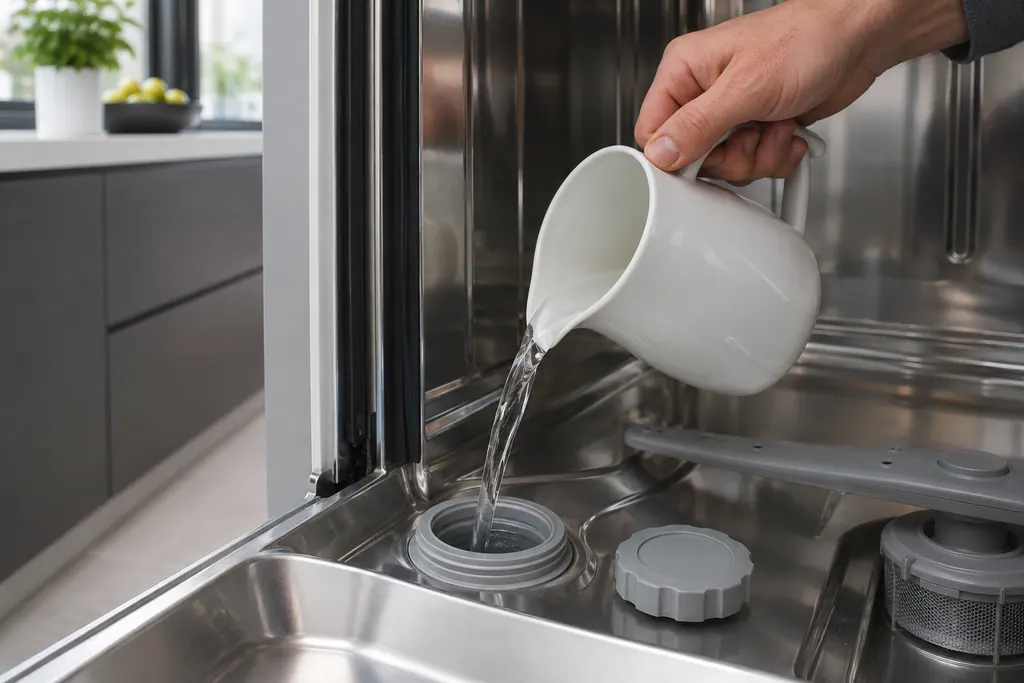
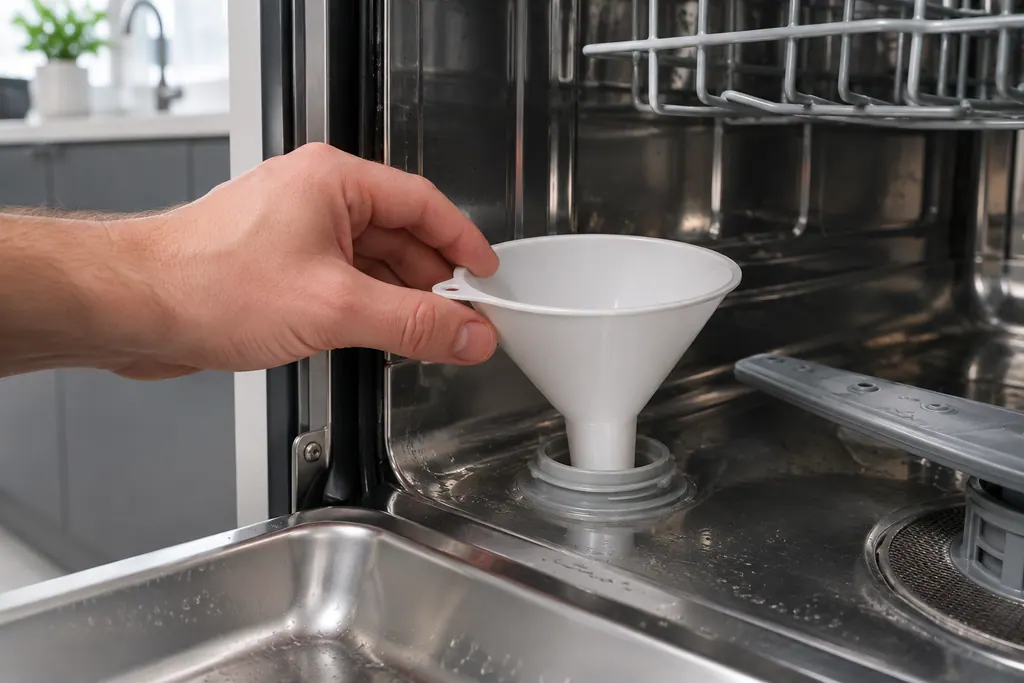
Take out the lower basket, unscrew the salt container lid, set the funnel on the opening and pour in dishwasher salt. The container holds about 4.4 lb (2 kg). Wipe the threads clean, screw the lid on firmly and run a program without a load. 1
- 1
- 2
- 3
- 4
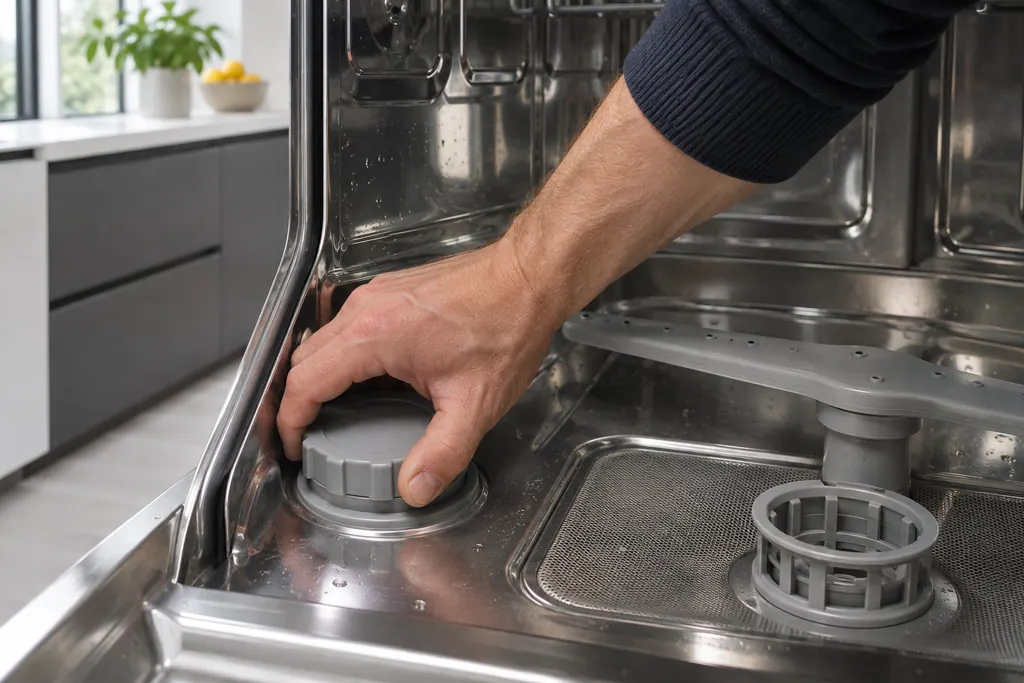
When the Insufficient salt message shows, refill and confirm with the center button. If the salt concentration has not built up yet, the message may stay on after you refill; confirm it again. 1
Three cautions from the manual matter more than the steps. Filling the salt container with dishwashing detergent, including liquid detergent, will damage the water softener. Only use salt made for dishwashers, because other salts may contain insoluble additives that impair the softener. And if you use detergent tabs that include salt, you should still add salt for the best cleaning result and for the long-term function of the softener. 1
How do I fill the rinse aid?#
Press the button on the reservoir toward the arrow until the flap springs open, pour in liquid rinse aid until it is visible at the screen, and press the flap shut until it clicks. The reservoir holds about 3.7 fl oz (110 ml). 1
Failing to close the flap all the way lets water in during the wash. Clean any spilled rinse aid, since the manual says that prevents over-foaming in the next program. 1 Only rinse aid made for residential dishwashers belongs in there; filling the reservoir with detergent, liquid or powder, will damage it. 1
The Refill rinse aid message means the reservoir has rinse aid for just 2 to 3 more programs, so add rinse aid once the program has finished and confirm with the center button. 1
How do I tune the rinse aid for spots or streaks?#
The dosage can be set between 0 and 6 ml, with 3 ml as the factory setting. If spots appear on the dishes, use a higher setting; if smearing or streaks show, use a lower one. 1
The troubleshooting table gives matching hints. For dishes that are not dry and glasses and cutlery that are spotted, the rinse aid setting may be too low or the reservoir empty, so increase the dosage and refill. Also check that a "Tab" product was not used, since tabs have a low drying effect. White residue on cutlery and dishes can mean not enough rinse aid. 1
For cloudy glassware and cutlery where a film wipes off, the first suspect is salt: the container is empty or its lid was not screwed on properly. 1 After refilling salt, the table says to start the Express program without a load and without the Turbo option, while the first-use pages name Rinse & Hold. Both are programs with no load, so follow the one your display offers. 1
What changes if I use detergent tabs?#
With tabs the rinse aid is not needed and both the salt and the rinse aid indicator can be switched off in Settings under Deactivate indicators. If you switch back to detergent without salt or rinse aid, refill both and turn the indicators back on. 1
The manual repeats that last warning in three places, so it is clearly a trap people fall into: tabs are used for months, the indicators are off, the salt runs out, and the glassware clouds. Detergent can be powder, gel or tabs; follow the dosage on the packaging, use only the recommended amount, and note that tabs are not recommended with the Express program because they may not dissolve completely. 1
Do the refill messages affect standby?#
Yes. While a refill message for salt or rinse aid is on the display, the dishwasher will not drop into standby, and refill messages are different from error messages: the first can be switched off with tabs, the second never. 1
The manual explains standby this way: a few minutes after the last key press, or at the end of a program, the dishwasher goes into standby to save energy, the display and indicators go dark, and only the power indicator flashes slowly. If refill salt or rinse aid is showing, or an error is present, it stays awake. The refill messages can be turned off when you use tab detergent; error messages cannot. 1 So a dishwasher that never goes dark may simply be asking for salt or rinse aid.
When does the glassware problem need a visit?#
Book when Insufficient salt stays on after refilling and confirming twice, when glassware stays cloudy with salt in and the lid tight, when an F or Waterproof message appears, or when water does not drain. 1
Book a technician with us and tell us the hardness you set, whether you use tabs and what the glasses look like. A price is quoted and approved by you before the work, with the exact amount fixed after the in-home diagnosis. Where the maker's warranty still applies, the maker handles the repair; work we do ourselves is covered separately by our own warranty. What a visit involves is on the dishwasher service page. For drain trouble, see a dishwasher that is not draining; for which error page fits your series, see the series guide.
Sources#
- Operating Instructions: Dishwasher G 5670, G 5675Miele, en-US, CA edition · M.-Nr. 09 510 241 · PDF pages 13-17 (before using for the first time), 31 (detergent), 42-45 (settings menu), 52-53 (frequently asked questions)